
How Thick Should Concrete Be for a Strong, Lasting Driveway?
How thick the concrete is in a driveway has a major impact on its long-term performance. Pouring too thin often leads to cracking and early repairs, while unnecessary thickness can increase costs without adding value. Today, we explain recommended driveway thicknesses and how volumetric concrete delivery helps achieve a precise, efficient pour.
Contractors and homeowners planning concrete driveway projects across Toronto, Scarborough, Markham, Vaughan, and the Greater Toronto Area rely on consistent, high-quality concrete to meet residential and commercial project standards. kreitmaker provides volumetric ready-mix concrete delivery six days a week from locations in Leaside, Scarborough, Davenport, and Stouffville, making it straightforward to get precisely the right amount and mix for any driveway thickness requirement — without over-ordering or wasted material.
What Is the Recommended Thickness for a Concrete Driveway?
For most residential driveway projects, concrete should be poured at a minimum thickness of five inches. This standard provides sufficient strength to support passenger vehicles while resisting surface wear over time. Driveways that experience heavier loads, such as delivery vehicles or work vans, often benefit from six inches or more, particularly in high-stress areas.
Commercial or industrial driveways typically require greater thickness, often eight inches or more, along with engineered base systems. These applications are designed for repeated heavy loads and must be approached differently than residential projects.
Minimum vs. Recommended Concrete Thickness
While five inches is considered the minimum acceptable thickness for residential driveways, thicker pours are recommended when vehicle weight, traffic frequency, or site conditions demand it. The goal is not to maximize thickness, but to match it to the application.
Concrete that is poured thinner than recommended is far more likely to crack, crumble, and deteriorate prematurely. On the other hand, pouring concrete thicker than necessary increases material costs and does not automatically improve performance if other fundamentals are ignored.
Factors That Affect Concrete Driveway Thickness
Vehicle Type & Load
One of the most significant factors is the type of vehicles using the driveway. Passenger cars and light SUVs place far less stress on concrete than delivery trucks, work vans, or trailers. Even occasional heavy vehicle access can justify a thicker pour in key areas.
Soil Conditions & Base Preparation
No matter how thick the concrete is, poor base preparation will lead to shifting and cracking over time. The subgrade, granular base, and drainage all play a critical role — this is covered in detail in the base preparation section below.
Climate & Mix Design
While climate itself does not dictate thickness, it does influence mix design. In Canada, freeze-thaw cycles require concrete mixes designed for durability, including appropriate strength and admixtures. The right mix helps concrete perform as intended at the chosen thickness. Volumetric concrete delivery with kreitmaker supports this by allowing concrete to be mixed on site, giving contractors precise control over strength and mix adjustments as conditions require, rather than relying on a fixed batch mixed off-site.
Joint Placement & Finishing Practices
Control joints give concrete a place to crack in a controlled way, reducing random surface fractures. Proper spacing, finishing techniques, expansion joints around pillars or structures, and attention to corners all contribute to long-term performance. Thickness works hand-in-hand with these practices, not independently.
The Importance of Proper Base Preparation
Concrete thickness alone does not determine driveway performance. Without a properly prepared base, even a thick concrete driveway can shift, crack, and fail prematurely. Base preparation is one of the most critical steps in any concrete driveway project and should never be overlooked.
A proper base begins with removing organic material and unsuitable soils, followed by compacting the subgrade to create uniform support. A well-installed granular base helps distribute loads evenly, reduces movement, and improves drainage beneath the concrete. This stability allows the concrete slab to perform as designed, regardless of thickness.
Good base preparation also works hand in hand with proper concrete practices, including correct mix design, finishing, and joint placement. Control joints give concrete a controlled place to crack, while expansion joints around pillars, edges, and transitions help accommodate natural movement. Without these elements in place, cracking can occur even when thickness requirements are met.
In short, thickness matters, but preparation matters more. A well-prepared base ensures that the chosen concrete thickness delivers long-term durability and reduces the risk of costly repairs.
Ready to start your concrete driveway project in Toronto or the GTA? kreitmaker's volumetric concrete delivery ensures you get exactly the right amount of the right mix — fresh, on site, six days a week. Get a quote from kreitmaker today.
How Proper Thickness Affects Cracking, Wear, & Maintenance Costs
Correct thickness reduces flexing under load, which minimizes cracking and surface wear. A driveway poured at the appropriate thickness is less likely to require early repairs, patching, or resurfacing, lowering long-term maintenance costs.
Over time, thin concrete tends to crack more frequently, allowing water penetration and accelerating deterioration. Thicker, well-supported concrete maintains its integrity longer, resulting in fewer issues and a better return on investment.
What Happens If Concrete Is Poured Too Thin?
Concrete that is too thin is more likely to crack under vehicle loads, break at edges, and deteriorate faster due to moisture penetration. These issues often lead to costly repairs or full replacement sooner than expected.
Is Thicker Concrete Always Better?
Not necessarily. Thickness alone does not guarantee performance. A properly prepared 5-inch driveway with correct jointing and mix design will often outperform a thicker driveway poured over an unstable base. Balance and planning are more important than simply adding more concrete.
Why Volumetric Concrete Delivery with kreitmaker Makes a Difference
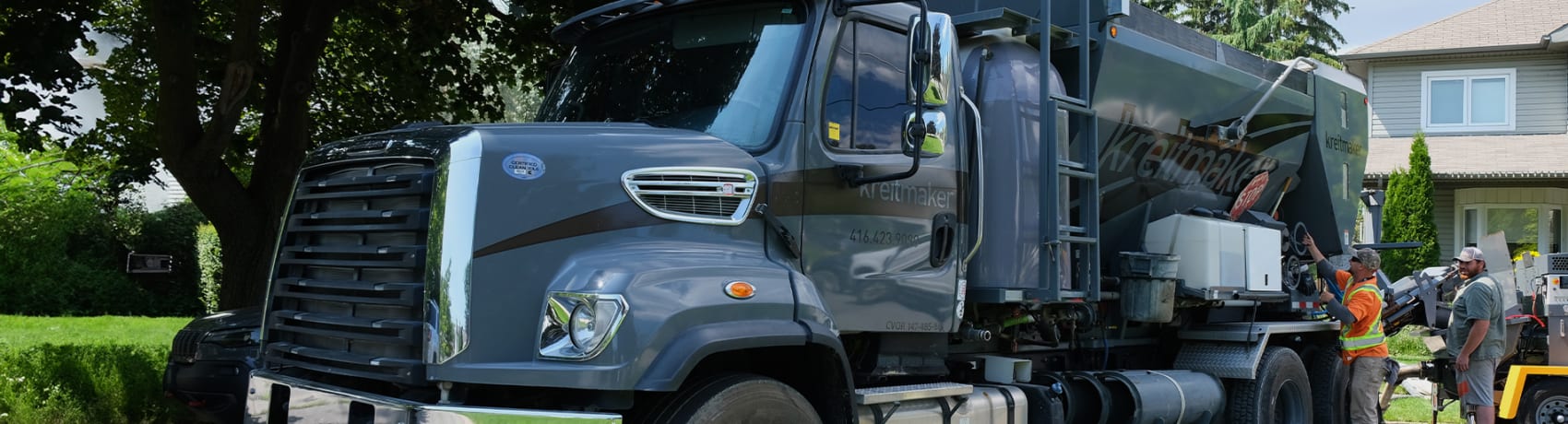
Volumetric concrete delivery with kreitmaker makes it easier to achieve the correct driveway thickness by mixing concrete on site and delivering exactly what the project requires. This allows for precise control of material usage, consistent quality throughout the pour, and reduced waste. Contractors and homeowners also benefit from paying only for the concrete they use, rather than over-ordering.
Ensure the Perfect Driveway with kreitmaker
A strong, lasting concrete driveway depends on choosing the right thickness, preparing the base correctly, and using the proper concrete mix and placement practices. When these elements work together, the result is a driveway that performs well and requires less maintenance over time.
At kreitmaker, we supply high-quality concrete using volumetric concrete trucks that provide precise control, same-day delivery six days a week, and personalized customer service. With strategic locations across the Toronto area and easy ordering through our app, getting the right amount of concrete has never been easier. Contact kreitmaker today to arrange concrete delivery for your next driveway project.